
Multi-location SEO drives more calls, direction requests, and booked jobs when every location page, listing, and data point stays consistent and verifiable. The three priorities that matter right now: build unique pages for every location, lock down listings so your name, address, and phone number never drift, and measure results with a geo-grid baseline instead of guessing. Get those three right and visibility gains follow. Skip them, and you're feeding AI systems bad data.
TL;DR:
- Accurate and consistent data across all locations is essential, as AI algorithms penalize mismatched hours, duplicate listings, and inconsistent information.
- Building unique, locally-rich location pages with specific FAQs, project examples, and staff bios helps improve rankings and avoid duplicate content issues.
- Managing Google Business Profiles at scale requires structured workflows, regular audits, and controlled access to prevent data drift and maintain profile completeness.
- Tracking geo-grid rankings, profile visits, calls, and review activity provides concrete metrics to measure local SEO progress effectively.
- Starting with audits of top locations, locking down master NAP data, and establishing a baseline ranking grid can prevent common operational failures and set a strong foundation.
Table of Contents
- What is multi-location SEO, and how has AI changed it?
- Why do multi-location SEO programs fail?
- What are the core components of a reliable multi-location SEO system?
- How do you build location pages that actually rank?
- How do you manage Google Business Profile at scale?
- How do you stop data drift across locations?
- How do you scale local content without creating thin pages?
- How do you measure and verify multi-location SEO results?
- How Digital Handshake Media runs the 12-week roadmap
- What three moves should you make this week?
- Get your free visibility report and a 12-week plan
- Sources
- FAQ
What is multi-location SEO, and how has AI changed it?
Multi-location SEO is the practice of optimizing your web presence, Google Business Profile, and citations so each of your physical locations ranks independently for its own local searches. Google still weighs relevance, distance, and prominence for every location separately. A five-location HVAC company doesn't get one shot at ranking. It gets five, and each one lives or dies on its own data quality.
Here's what changed. AI-driven discovery tools now treat inconsistent data across platforms as a direct disqualifier, not a minor annoyance. When your citations conflict or your hours don't match between your website and your Google Business Profile, AI search treats that mismatch as a visibility liability and simply routes the recommendation elsewhere.
AI systems checking your locations before recommending them look at:
- Whether your posted hours match across your website, GBP, and third-party directories
- Review recency and whether the business actually responds to them
- Whether your listed services match what the location page and GBP both claim you offer
One weak location can quietly drag down how AI treats your entire brand.
Why do multi-location SEO programs fail?
Most multi-location programs don't fail because of a bad strategy. They fail because of operational sloppiness that compounds across dozens or hundreds of locations. Four failure modes show up over and over.
- NAP drift and shared phone numbers. A franchise adds a new location, reuses the corporate tracking number from another city, and now two locations report the same phone number to Google. NAP consistency tools like Yext can catch this at scale, but only if someone actually runs the audit.
- Template-thin location pages. Swapping the city name into an identical paragraph across 40 pages isn't local content. Google and AI crawlers both flag this pattern as duplicate content, and it tanks rankings for every location using the template.
- Internal ownership silos. The web team manages the site. The ops team manages GBP. Nobody owns the connection between them. A location closes for renovations and the website says "open" for three weeks because no single person was responsible for updating both.
- Cannibalization between local and national pages. Your homepage targets "roofing contractor" broadly while your Chicago location page also targets "roofing contractor Chicago." Google can't tell which page deserves to rank, so neither one performs well.
Each of these is fixable, but only if someone catches it before it becomes the default state across your entire footprint.
What are the core components of a reliable multi-location SEO system?
A system that actually holds up across ten, fifty, or two hundred locations needs six pieces working together. Skip one and the others start compensating for gaps they weren't built to cover.
- Site architecture. Subfolders (yoursite.com/locations/city) instead of subdomains or separate domains, so every new location inherits your existing domain authority instead of starting from zero.
- Structured data. A unique LocalBusiness JSON-LD block on every location page with exact name, address, phone, hours, and geo-coordinates, with the sameAs property linking to the verified Google Business Profile for that specific location.
- Google Business Profile completeness. Full category selection, an accurate service list per location, and no gaps in attributes that AI tools use to filter recommendations.
- Citation management. Consistent NAP data across every directory that indexes your business, prioritized toward the citation sources most relevant to your industry and service area.
- Review velocity and response rate. Steady review volume per location, with owner responses, functions as a prominence signal that both Google and AI systems weigh when deciding which location to surface.
- Geo-grid measurement. A baseline scan showing exactly where each location ranks across a grid of points in its service area, not just a single averaged position.
Pro Tip: Run your citation audit location by location, not brand-wide. A single bad citation on one location's profile can suppress that location in the map pack while the rest of your footprint looks fine on paper.
Get any one of these wrong and the others can't fully compensate. A location page with flawless schema still won't rank if the GBP listing shows the wrong hours.
How do you build location pages that actually rank?
Site architecture decisions made early get expensive to reverse later, so get the structure right the first time. Subdirectories are the default choice for a reason: a new location page under /locations/denver inherits domain authority your site has already built, while a subdomain or a separate domain starts from scratch. Search Engine Land's analysis of multi-location structures backs subfolders as the standard recommendation for exactly this reason.
Page depth matters more than most owners expect. Aim for at least 800 words of genuinely unique local content on priority locations. That's not padding. It's room for the specifics that make a page useful: which neighbourhoods you service, what a typical job looks like in that market, and what local regulations or conditions affect the work. For lower-priority locations where 800 words of unique copy isn't realistic yet, substitute local assets instead: a staff bio for the technician based there, project photos from actual jobs in that city, or a short local case study.
Every location page needs:
- A dedicated LocalBusiness schema block with that location's exact address and geo-coordinates
- The sameAs property pointing to that location's verified GBP, not a generic corporate profile
- At least one piece of hyper-local proof: a review quote, a photo, or a specific street or neighbourhood reference
For service-area businesses without a public storefront in every market, a hybrid model works better than claiming a phantom address. Keep verified hub pages for your actual locations, then build honest service-area landing pages for the territories you cover from those hubs. Transparency about what's a real office versus a coverage area protects you from GBP suspension risk.
How do you manage Google Business Profile at scale?
Managing ten profiles by hand is tedious. Managing 100 by hand is how data drift happens. Google's own Business Profile Manager tools exist to solve exactly this problem, but they come with rules you need to follow closely.
- Set up location groups. Business Profile Manager lets you organize multiple locations under one account, which is the foundation for any bulk action you'll take later.
- Use bulk upload for new locations, carefully. Google supports bulk verification for eligible accounts with ten or more locations, but eligibility depends on clean, accurate data going in. A messy spreadsheet triggers manual review instead of speeding things up.
- Run duplicate detection before you scale. Old listings from previous management companies, staff turnover, or address changes create duplicate profiles that split your reviews and confuse the map pack algorithm. Clean these up before adding new locations, not after.
- Treat profile completeness as a ranking input, not paperwork. Locations with full category selection, complete service lists, and populated attributes get included in AI-driven recommendations more often than sparse profiles. This isn't a formatting nicety. It's the raw material AI tools use to decide who to surface.
Bulk verification speeds up rollout, but Google may still ask for manual evidence on a sample of locations, so keep storefront photos and consistent corporate documentation ready before you submit.
How do you stop data drift across locations?
The single biggest predictor of a multi-location program's long-term health isn't the initial setup. It's whether you have a governance process that survives staff turnover, franchise growth, and six months without anyone checking in.
The model that works combines central control with local input. Search Engine Land's research on multi-location structure points to fragmented ownership between web, listings, and operations teams as the most common failure point, and recommends a hybrid model as the fix. Central teams set the standards: schema requirements, minimum content length, brand voice. Local managers or franchisees contribute the details only they know: which neighbourhoods they actually service, recent job photos, staff changes.
A few structural pieces make this hold together:
- A master location dataset that functions as the single source of truth for every address, phone number, and hours listing across the business
- A quarterly audit, at minimum, checking for NAP drift, duplicate listings, and query cannibalization between location pages
- A clear permission model so franchisees or location managers can update their own local details without being able to touch schema, URL structure, or brand-wide settings
Pro Tip: Give every location manager write access to their own reviews and photos, but lock schema and technical fields behind a central admin. That split alone prevents most of the drift that shows up in year-two audits.
Without this structure, entropy wins. Every location manager who updates hours without telling anyone else is a small crack that widens over time.
How do you scale local content without creating thin pages?
The instinct to template everything is understandable when you're managing dozens of locations, but templated pages with swapped city names are exactly what triggers duplicate-content penalties. The fix isn't more content. It's more specific content, built through a repeatable process instead of a copy-paste habit.
The components that genuinely differentiate a location page:
- A neighbourhood-specific FAQ addressing questions unique to that service area (permit rules, common local issues, seasonal factors)
- A short case study from an actual job completed at that location, with real details
- A staff bio for the technician, adjuster, or provider based there
- A photo gallery from real jobs, not stock imagery
Build a template that enforces structure while forcing unique content in the sections that matter: one fixed layout, but with mandatory local variables that can't be left blank or auto-filled with generic text.
When should you merge pages instead of keeping them separate? If a Search Console query-overlap audit shows two location pages competing for the same local search terms with no meaningful population or service difference between them, merge them into one stronger page rather than letting them split traffic. Two locations ten minutes apart in the same suburb rarely need separate pages.
One firm rule on automation: never let a script auto-generate the unique local sections. Automate the schema, automate the template structure, automate the internal linking. Never automate the case study, the staff bio, or the FAQ answers. That's where thin content starts.
How do you measure and verify multi-location SEO results?
You can't manage what you don't measure, and averaged, brand-wide metrics hide exactly the problems you need to see. A geo-grid scan plots your ranking at dozens of points across a location's service area, showing you precisely where visibility drops off instead of masking a weak zip code behind a strong average.
Core KPIs worth tracking per location:
- Map pack impressions and ranking position across the grid
- GBP profile visits and direction requests
- Phone calls generated directly from the profile
- Review velocity and response rate
After any AI tool surfaces your business in a recommendation, users frequently verify that recommendation by checking your site or GBP directly. Run a quick match check: do your hours, service list, and recent reviews on your profile actually match what the AI just told the user? A gap here erases the trust the recommendation just built.
A structured 12-week roadmap should move these numbers in a specific order: baseline visibility first, listing and schema fixes next, then measurable gains in calls and direction requests by week 12.
How Digital Handshake Media runs the 12-week roadmap
Digitalhandshakemedia's 12-week roadmap starts by mapping your actual Google Maps visibility before you commit to anything, so you see the performance gap first, not after signing a contract. From there, the roadmap works through GBP cleanup, schema deployment, and citation fixes on a fixed timeline, with continuous geo-grid scans tracking progress against that opening baseline.
Map Check-Ins run in the background between roadmap phases, converting field jobs into live site pins and geo-posts automatically, so your visibility signals keep updating even between active campaign pushes.
[Case study placeholder: insert client-specific geo-grid before/after metrics and location count here once available.]
What three moves should you make this week?
Most owners overthink the starting point. Start with three things. Audit your ten highest-priority locations first, not all of them at once, and check for mismatched hours, duplicate listings, and thin page content. Second, lock a master NAP record for every location in one spreadsheet or system that everyone updates from, no exceptions. Third, run a geo-grid baseline before you touch anything else, so you have a real number to measure against instead of a gut feeling about whether things improved.
Here's my honest read on when to bring in an agency versus handling it internally: if you're managing more than 15 locations, if GBP verification keeps stalling on manual review, or if nobody on your team has two full days a month to run audits, hand it off. Below that scale, with real discipline, you can run this yourself. Above it, the coordination cost usually exceeds what an agency charges.
Run your free visibility report before deciding either way. It tells you which category you're actually in.
— Omar
Get your free visibility report and a 12-week plan
There's a real difference between hiring a generalist agency to "handle SEO" across your locations and getting a plan built around your actual Google Maps visibility gaps first. Digitalhandshakemedia is the alternative to guessing: instead of a proposal built on assumptions, you get a mapped baseline of exactly where each of your locations ranks before you spend a dollar.
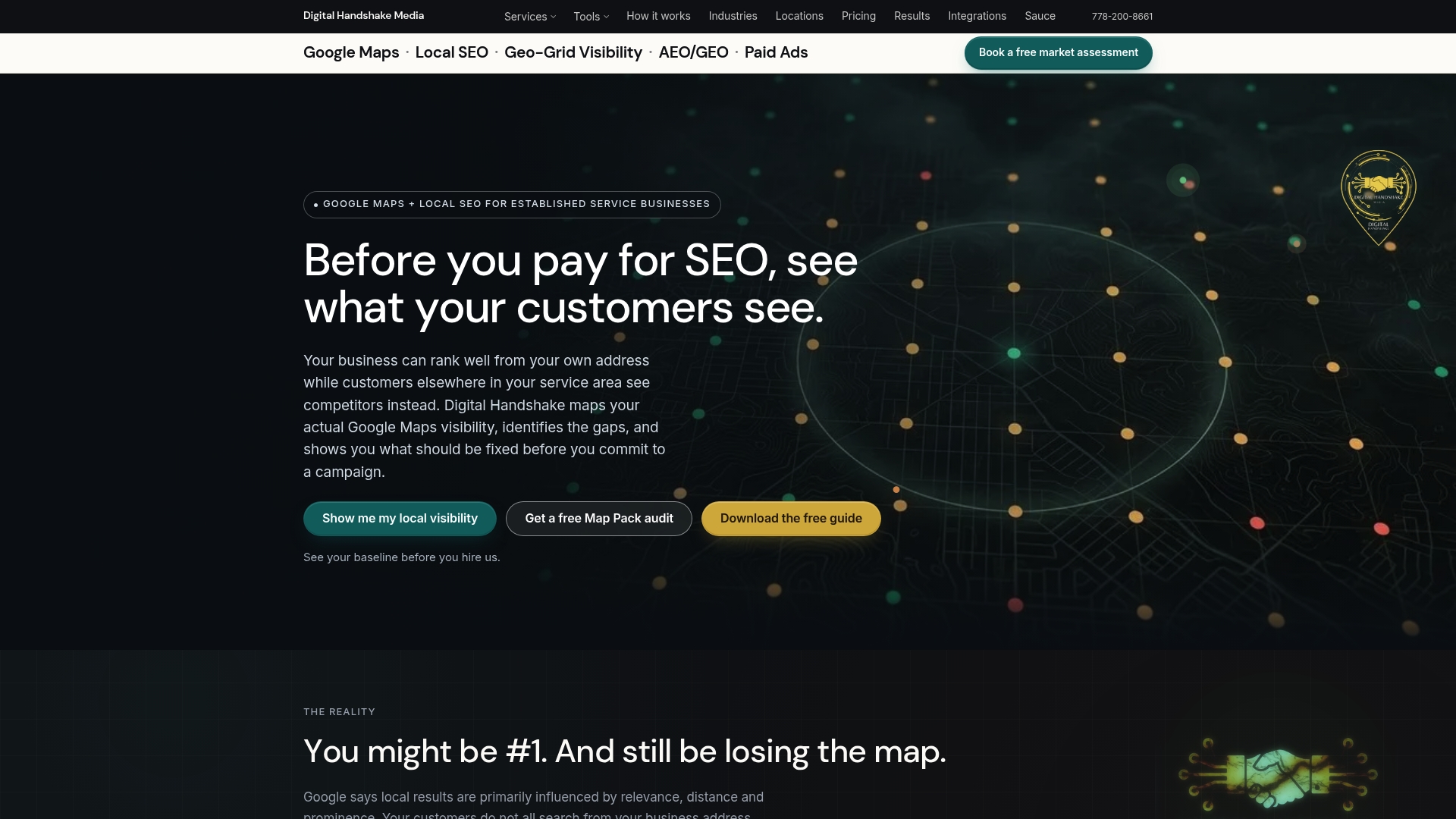
The free visibility report shows you the performance gaps location by location, using the same geo-grid scanning method covered above, so you can see where you're losing map pack visibility before committing to a fix. From there, Map Check-Ins at $299/month keeps that visibility current between roadmap phases by turning completed field jobs into live geo-posts automatically, no manual updates required.
If you're running more than a handful of locations and can't remember the last time someone audited your NAP consistency, that's the signal to act. Start with the 12-week local SEO roadmap and see your visibility report for free before you decide on anything else.
Sources
- The Complete Guide To Local SEO For Multiple Locations | Search Engine Journal
- AI Search Exposes Local Inconsistency Gaps | Street Fight
- Manage multiple locations - Google Business Profile support
- The best website structure for a multi-location business | Search Engine Land
FAQ
Is SEO still worth it for multi-location businesses?
Yes. Local search remains the primary way customers find service businesses near them, and AI-driven discovery tools now raise the bar for data consistency rather than replacing the need for it. Businesses with clean listings and unique location pages still capture the calls and direction requests that untracked competitors miss.
What is the 80/20 rule as it applies to multi-location SEO?
Prioritize your highest-traffic or highest-revenue locations first rather than treating every location equally on day one.
What are the main types of SEO a multi-location business needs?
Four types matter most: technical SEO (site structure and schema), on-page SEO (unique location content), local SEO (GBP and citations), and off-page SEO (localized backlinks and reviews). A multi-location program fails if any one of these is neglected across even a handful of locations.
Is SEO dead now that AI answers questions directly?
No, but the requirements shifted. AI tools still pull from the same underlying signals, GBP data, citations, schema, and reviews, and they're stricter about consistency than traditional search ever was. A business with accurate, verifiable data across every location is more likely to get recommended, not less.
How many locations qualify for Google's bulk verification?
Google's bulk verification process is available to eligible accounts managing ten or more locations, though eligibility still depends on submitting accurate, consistent data and may require manual verification on a sample of listings.
Recommended
- Geo-Grid Ranking | See Your Real Google Maps Visibility
- The 2026 Local Ranking Reality
- Local Search Numbers That Make You Uncomfortable
- Local SEO Delta BC | Google Map Pack Visibility
Written with BabyLoveGrowth to get found on Google and AI search