
Fix your Google Business Profile setup and publish focused, unique city pages before touching anything else; that combination moves local pack visibility within weeks. Digital Handshake Media builds this exact sequence into its 12-week roadmap, starting with geo-grid baselines. Expect early signal shifts fast, but treat a few months as the honest timeline for measurable lead gains.
TL;DR:
- Verifying and optimizing your Google Business Profile with accurate service areas and categories is essential before building city pages to ensure visibility.
- Creating unique, detailed city-specific pages with local content, schema markup, and testimonials significantly improves local relevance and ranking potential.
- Regular geo-grid scans and tracking key metrics such as local pack impressions and reviews are crucial for measuring progress and adjusting strategies.
- Prioritizing high-revenue cities within a two-hour drive, and focusing on GBP, reviews, and city pages first, yields faster results with limited time or budget.
- Building genuine local partnerships and community links provides stronger geographic signals than generic directory listings to enhance local SEO authority.
Table of Contents
- What is service area business SEO and why does it work differently
- The core optimization checklist: GBP, city pages, schema, reviews, citations
- Choosing your cities and building a realistic 12-week plan
- Measuring visibility: geo-grid scans and the KPIs that matter
- How Digital Handshake Media runs the 12-week roadmap
- Mobile optimization matters more for service area searches
- Local content beyond city pages: FAQs, blog posts, and neighbourhood detail
- Voice search changes how service area businesses need to answer questions
- Building local links through partnerships and community involvement
- Managing overlapping service zones across multiple locations
- Technical SEO essentials: speed and crawl budget for SABs
- What to prioritize with limited time or budget
- Get a geo-grid baseline before you spend another dollar on SEO
- Sources
What is service area business SEO and why does it work differently
A service area business, or SAB, serves customers at their location instead of a storefront: plumbers, electricians, cleaners, lawyers who do house calls, mobile mechanics. Google ranks local results using three inputs: relevance, distance, and prominence, and distance calculations get complicated fast when there's no public address anchoring the business to a point on the map.
That's the core problem. A storefront gets a fixed pin. An SAB that hides its address on its Google Business Profile is telling Google "I don't have one location, I have a coverage zone." Google still needs geographic signals to decide who shows up for "electrician near me" in a specific suburb. It looks for those signals wherever it can find them: your GBP service-area list, your website content, your citations, your reviews.
This is where most SABs shoot themselves in the foot. Two mistakes show up constantly:
- Doorway pages. Swapping the city name into an identical template across twenty pages reads as thin and manipulative to both Google and visitors, and Search Engine Land's guidance on service area pages is blunt about it: these pages need actual local substance, not a find-and-replace job.
- Overbroad service-area settings. Claiming coverage across an entire state or province dilutes relevance everywhere. Google's own advice is to keep service areas within roughly a two-hour drive of your base, because relevance signals get diluted past that point.
Get the geography right first. Everything downstream, from schema to reviews to link building, depends on Google already trusting your radius.
The core optimization checklist: GBP, city pages, schema, reviews, citations
This is the sequence Digitalhandshakemedia runs with clients, roughly in this order, because each layer reinforces the one before it.
-
Lock down your Google Business Profile. Verify the listing, hide the address if you're a true SAB, and list every service area by city or postal code rather than a vague region. Choose your primary category with precision; "plumber" outranks "contractor" if plumbing is genuinely your main service. Fill in every service, attribute, and business description field GBP offers. Incomplete profiles read as low-effort to Google's algorithm.
-
Build unique city pages, not templates. Each page needs its own content: which neighbourhoods you cover, typical job types in that area, a local price range if you're comfortable sharing one, and at least one testimonial or case reference tied to that city. Whitespark's guide to service area landing pages recommends including a local phone number, a map embed, and a clear call-to-action above the fold, since conversion elements matter as much as the words on the page.
-
Set canonical tags and internal links correctly. Every city page should link back to your core service pages, and your GBP listing should link to the specific city page when the service area matches, not just your homepage.
-
Add LocalBusiness schema with areaServed markup. Structured data using Schema type, with an
areaServedproperty or aGeoShaperadius, gives Google a machine-readable confirmation of what your visible content already says. Place the JSON-LD in the page head or footer of each city page, matched to that specific page's service area, not a single blanket script site-wide. -
Build a review request workflow. Automate the ask right after job completion, ideally through a text or email trigger from your CRM or invoicing tool. Encourage customers to mention their neighbourhood or city in the review text itself. Reviews that reference a specific area strengthen geographic relevance in a way generic five-star reviews don't.
-
Handle negative reviews within 48 hours. Respond calmly, take ownership where warranted, and invite the reviewer to continue the conversation offline. A pattern of unanswered negative reviews damages prominence signals more than the reviews themselves.
-
Audit your citations for NAP consistency. Your name, address (or service-area statement), and phone number need to match exactly across every directory: Google, Bing Places, Apple Maps, Yelp, industry-specific directories, and local chambers of commerce. Even small variants, "St." versus "Street," can weaken the trust signal.
-
Prioritize sector-specific and city-specific directories over generic national listings. A local chamber of commerce directory or a regional trade association listing often carries more geographic weight for an SAB than a fifth generic national citation site.
Pro Tip: Run your citation audit before you build a single city page. Cleaning up inconsistent NAP data first means every new page and listing you add afterward reinforces a clean signal instead of adding to the confusion.
A practical starting checklist looks like this: verify GBP categories and services, confirm NAP across your top ten directories, gather at least ten local job-site photos per priority city, and set an automated review request that realistically captures a fifth to a third of customers responding within 48 hours, based on typical SAB benchmarking data. None of this is exotic. It's disciplined, and it's the discipline most SABs skip.
Choosing your cities and building a realistic 12-week plan
Don't try to optimize for every city in your service area at once. Rank your cities by three factors: revenue potential from that area, search volume for your core services there, and how close the city sits within your practical service radius. Google's own two-hour drive guideline is a useful cutoff for how far you should even claim coverage, and it's a reasonable filter for where to spend content-building effort too.
Start with your top three to five cities. A roofing company covering a metro area might discover that two suburbs generate 60% of past-year revenue despite representing a fifth of their listed service area. Those two get city pages, dedicated review pushes, and citation work first. The rest can wait.
A workable 12-week structure:
- Weeks 1 to 2: Audit GBP, citations, and existing site content. Run a geo-grid baseline scan.
- Weeks 3 to 6: Build and publish city pages for your top-priority markets, with schema markup and internal linking in place.
- Weeks 7 to 9: Launch the review request workflow, begin local outreach for citations and partnerships, fix any technical issues the audit flagged.
- Weeks 10 to 12: Re-run geo-grid scans, compare against baseline, and adjust which cities get the next round of investment.
Resource-wise, expect roughly 4 to 8 hours of content writing per city page if you want it done properly rather than templated, a few hours of photography or client coordination for authentic job-site images, some developer time for schema and canonical setup, and a modest monthly line item if you use a paid review-request or geo-grid tool. None of this requires a large team. It requires sequencing.
Measuring visibility: geo-grid scans and the KPIs that matter
A single rank check tells you almost nothing useful for an SAB. Checking "plumber near me" from your office address shows one point on the map; your actual customers are searching from dozens of different points across your coverage zone, and your visibility can vary wildly between them.
Geo-grid scans solve this by checking rankings from a grid of points spread across your service area, revealing exactly where you rank strong and where you're invisible. A contractor might rank third in the map pack downtown and not appear at all fifteen kilometres out, a pattern a single-point check would completely miss. Running a baseline scan before you optimize anything is important too, because local pack rankings shift naturally week to week, and without a baseline you can't tell whether a change is your work or normal volatility.
Track these on a regular cadence:
- Local Pack impressions and appearances, by city, weekly.
- GBP profile actions, calls, direction requests, website clicks and booking clicks, weekly.
- Organic rank by city page, for your priority keyword-city combinations, monthly.
- Review velocity and review content, tracking how many new reviews mention a specific location, monthly.
A practical workflow: run a geo-grid scan monthly, pull GBP insights weekly, and check organic city-page rankings once a month against your priority list. If a specific city stalls for two consecutive scans, that's your signal to look at content depth, review count, or citation gaps in that specific market.
How Digital Handshake Media runs the 12-week roadmap
Digitalhandshakemedia built its process around one uncomfortable truth: most SABs can't tell whether their SEO spend is working until months after they've committed to it. The geo-grid ranking approach flips that. Clients see a visual baseline of exactly where they rank across their service area before any optimization work starts, then watch the grid shift as the work progresses.
The roadmap breaks into three phases:
- Baseline and audit, weeks 1 to 2: geo-grid scan across the full service area, GBP audit, citation and NAP check, technical site review.
- Optimization sprints, weeks 3 to 9: city page builds for priority markets, schema deployment, review workflow launch, citation cleanup and building.
- Measurement and iteration, weeks 10 to 12: follow-up geo-grid scan compared directly against baseline, a dashboard showing which cities moved and which still need work.
Outcomes vary by market competitiveness and how neglected the profile was to start; a business in a low-competition suburb sees faster grid movement than one competing against a dozen well-optimized rivals downtown. What stays consistent across clients is the baseline-to-follow-up comparison itself: a documented before-and-after rather than a vague promise that rankings "improved."
Mobile optimization matters more for service area searches
Most "near me" searches happen on a phone, often from someone standing in their driveway looking at a leaking pipe or a broken lock, not sitting at a desk. That context changes what your site needs to do well.
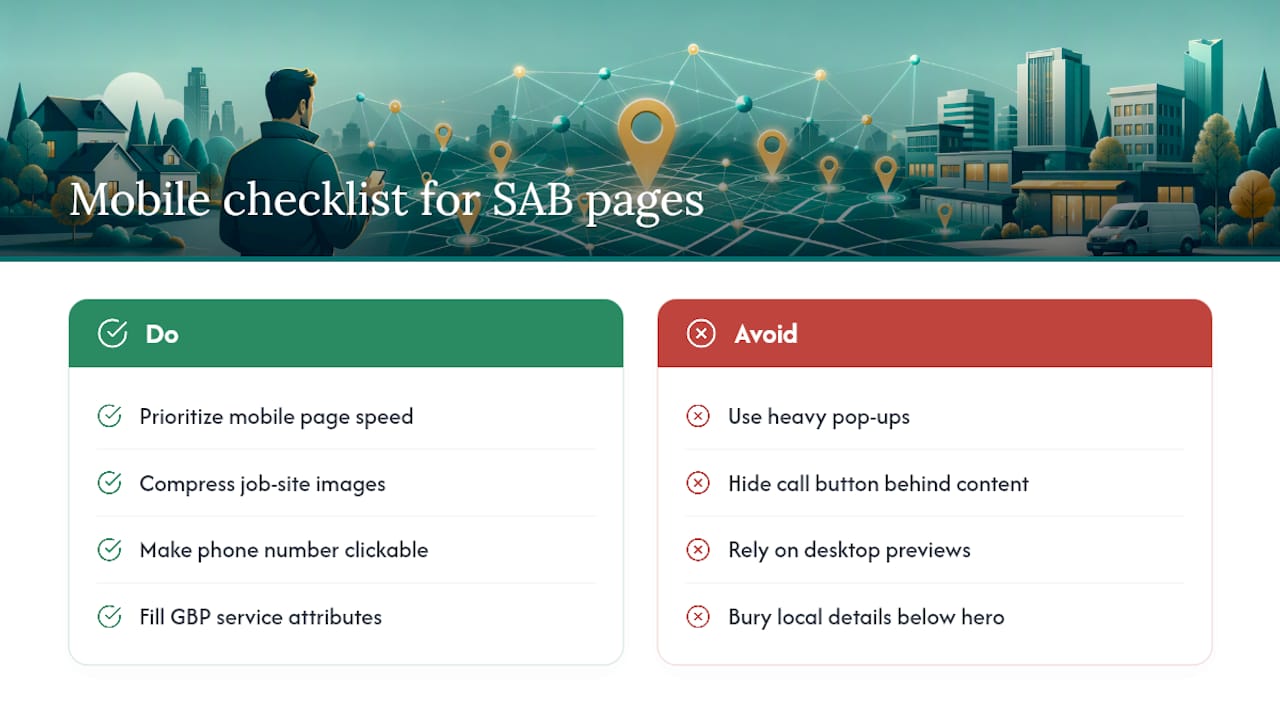
Page speed on mobile is non-negotiable for an SAB specifically because these searches skew high-urgency. A slow-loading city page loses a caller who's already decided to phone the next result instead. Compress images (especially those local job-site photos you've been gathering), avoid heavy pop-ups that block the tap-to-call button, and make sure your phone number is a clickable link, not just text, on every city page.
Your GBP listing itself is mobile-first by design; most people interacting with it are tapping "Call" or "Directions" straight from a map result. That's exactly why filling in every service and attribute field matters so much: mobile users often act on the profile card alone without ever visiting your website.
Test your own city pages on an actual phone, not just a browser's mobile preview. Check whether the click-to-call button is reachable with a thumb, whether the map embed loads without eating your data allowance, and whether the page renders your local details, neighbourhood names, service specifics, above the fold instead of buried below a hero image. Small friction points cost real calls for a business whose customers are searching in the moment they need help.
Local content beyond city pages: FAQs, blog posts, and neighbourhood detail
City pages carry the core weight, but they shouldn't carry all of it. A localized FAQ section, either on each city page or as a standalone resource, captures the specific questions customers in that area actually ask: permit requirements that vary by municipality, typical response times for that neighbourhood, or pricing quirks tied to local conditions.
Blog posts give you room to go deeper without cluttering your service pages. A pest control company might publish a post on seasonal ant patterns specific to a particular region's climate, or a landscaper might write about drainage issues common to a specific neighbourhood's soil type. This content does double duty: it answers real questions, and it naturally reinforces the geographic relevance signals your city pages establish.
The trap to avoid is treating local content as a volume game. Ten thin blog posts stuffed with city names do less for you than two genuinely useful posts that answer a real local question in detail. Search Engine Land's guidance on avoiding thin, templated content applies just as much to blog posts as it does to service-area pages themselves.
Tie every piece of local content back to a relevant city or service page with a natural internal link. A blog post on winter pipe freezing risks in a specific region should link straight to that region's plumbing service-area page, not just your homepage.
Voice search changes how service area businesses need to answer questions
Voice queries lean conversational and specific: "who's the closest emergency locksmith open right now" instead of "24 hour locksmith." That shift rewards businesses whose content answers direct questions in plain language, because voice assistants tend to pull from content structured as a clear question and answer.
Your localized FAQ content is your best asset here. Structure questions the way a real customer would speak them, "how fast can someone get to my house in [city] for a burst pipe," and answer directly in the first sentence. Voice assistants generally favour concise, direct answers over paragraphs of preamble.
GBP data matters even more for voice results, since many voice searches pull straight from Google's local index rather than crawling your website at all. Complete GBP attributes, accurate hours, and current service area settings feed directly into what a voice assistant reads back to the person asking. A profile with an emergency-service attribute checked and hours marked accurately is more likely to surface for "who's open now" style queries than one with generic, unverified details.
There's no separate "voice SEO" checklist to run. The GBP completeness and locally-specific FAQ content covered earlier in this article are the same work that improves voice visibility. Getting one right largely gets you the other.
Building local links through partnerships and community involvement
Generic guest-post link building rarely moves the needle for an SAB the way genuine local partnerships do. A link from your city's chamber of commerce, a local trade association, or a community sponsorship page carries geographic weight that a national guest post simply can't replicate, because it tells Google a real local entity vouches for you.
Sponsoring a youth sports team, a community cleanup event, or a local charity run often earns a natural backlink from that organization's website, along with genuine community goodwill that translates into referrals. Partnering with complementary local businesses, a plumber cross-referring with an electrician in the same service area, for instance, can produce mutual links and shared customer trust that a cold outreach email never will.
Local news coverage is another underused avenue. Reaching out to a community newspaper or local news site with a genuinely newsworthy angle, a milestone, a community project, a notable job, can earn coverage and a link that carries real local authority. This takes more effort than buying a directory listing, and that effort is exactly why it works better.
Managing overlapping service zones across multiple locations
Multi-location SABs run into a specific problem: two branches serving adjacent territories can end up competing against each other in search results, or worse, confusing Google about which location actually serves a given city.
The fix starts with clear, non-contradictory GBP service-area settings for each location. If Branch A and Branch B both cover the same suburb, decide deliberately whether that's intentional, some businesses genuinely want both locations visible there, or whether one location should defer to the other to avoid diluting both listings' relevance.
Content structure matters just as much. Build one city page per city, not one per branch per city. If two locations both serve a shared market, that page should reflect the business as a whole rather than favouring one branch's internal metrics over the other. Internal linking should route users logically: a city page for a shared market can note which branch handles that area for scheduling purposes without creating two competing, thin, duplicate pages.
Canonical tags become critical here. If similar city content exists across a multi-location site, an unclear canonical structure risks Google indexing the wrong version or treating pages as duplicates and suppressing both. Assign one clear canonical version per city and stick to it.
Technical SEO essentials: speed and crawl budget for SABs
Site speed carries extra weight for SABs because so many city pages exist on a single domain. A slow-loading template multiplied across twenty cities compounds the problem twenty times over, and Google's crawlers notice patterns like that just as much as users do.
Crawl budget, essentially how much of your site Google's crawler bothers to index in a given period, becomes a real concern once you're running dozens of city pages. A site with excessive thin or near-duplicate pages risks Google crawling less of it overall, deprioritizing your most valuable pages in favour of pages that add little unique value. This is one more reason to favour a smaller number of genuinely unique city pages over a large number of templated ones.
Clean, consistent internal linking helps Google's crawler find and prioritize your priority pages efficiently. An XML sitemap that's kept current, with low-value or outdated pages removed rather than left to accumulate, also helps crawlers focus where it matters.
Image weight deserves specific attention for SABs, since local job-site photography is exactly the kind of content that strengthens city pages, but unoptimized images are also the most common cause of slow mobile load times. Compress every photo before it goes live, and use modern formats where your platform supports them.
What to prioritize with limited time or budget
If you can only do three things this quarter, do them in this order: fix your GBP and launch a review workflow first, build your top three city pages second, and start geo-grid measurement third. That sequence exists because GBP and reviews move fastest and cost the least, city pages take longer to write and index, and measurement only means something once you have a baseline to compare against.
Consider hiring outside help when you genuinely lack a developer for schema and canonical work, when nobody on your team has time to chase reviews consistently, or when you need geo-grid data and don't have the tooling to get it. Those are legitimate gaps, not signs of failure.
Watch for red flags: any provider promising a specific ranking position, anyone who won't show you a baseline before charging you, and anyone recommending you claim a service area far wider than a realistic drive time. Those are the traps that waste a quarter of your budget with nothing to show for it.
— Omar
Get a geo-grid baseline before you spend another dollar on SEO
Digitalhandshakemedia is the practical alternative to guessing your way through local SEO. Instead of paying for months of vague "optimization" work with no way to verify it's doing anything, you get a documented geo-grid baseline first, then a 12-week roadmap built around the specific cities where your business actually loses visibility.
That roadmap covers everything this article walked through: GBP setup and category selection, city-page builds with real local detail, schema deployment, a review workflow that captures location mentions, and citation cleanup across the directories that matter for your sector. You see exactly which service areas need work before committing budget to fix them, and you get a follow-up geo-grid scan at the end that shows the shift against your original baseline, not a promise, an actual comparison.
If you're deciding where to start, request a free Google Map Pack audit and see your current visibility gaps mapped out before you commit to anything. For businesses ready to move straight into a structured engagement, the local SEO services page outlines what the full 12-week roadmap includes city by city.
Sources
- Tips to improve your local ranking on Google
- Service area pages: Boost local SEO across locations
- Our best local SEO tips to rank higher in 2026 | WordStream